Gainesville mudroom
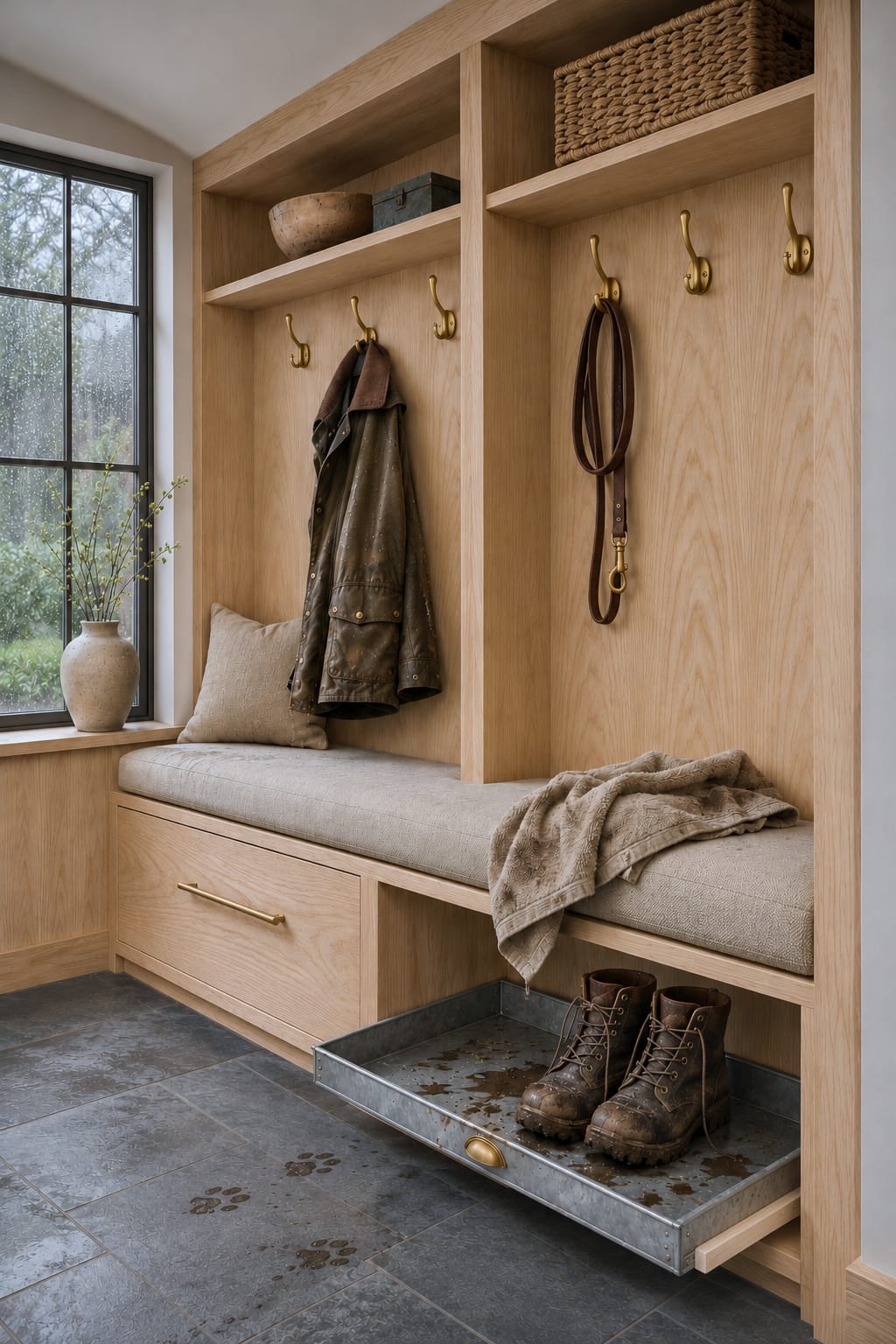
White ash lockers beside a back door that is never fully closed: a busy family, two dogs and the weather.
The brief
A busy family and two dogs come in through this door. It had to take the weather and still look kind.
Hooks for everyone, somewhere to sit and pull boots off, and a home for the dog leads that is not the newel post.
The ash comes from trees lost to the emerald ash borer, milled near the shop. It is pale, tough and open-grained, and it takes a finish that can be repaired in place.
The way in
Door, hook, bench, tray
The room is organized in the order a wet family arrives: the slate takes the first steps, the hooks come next, then the bench to sit and pull a boot, and the tray under it for the boots.
- 01
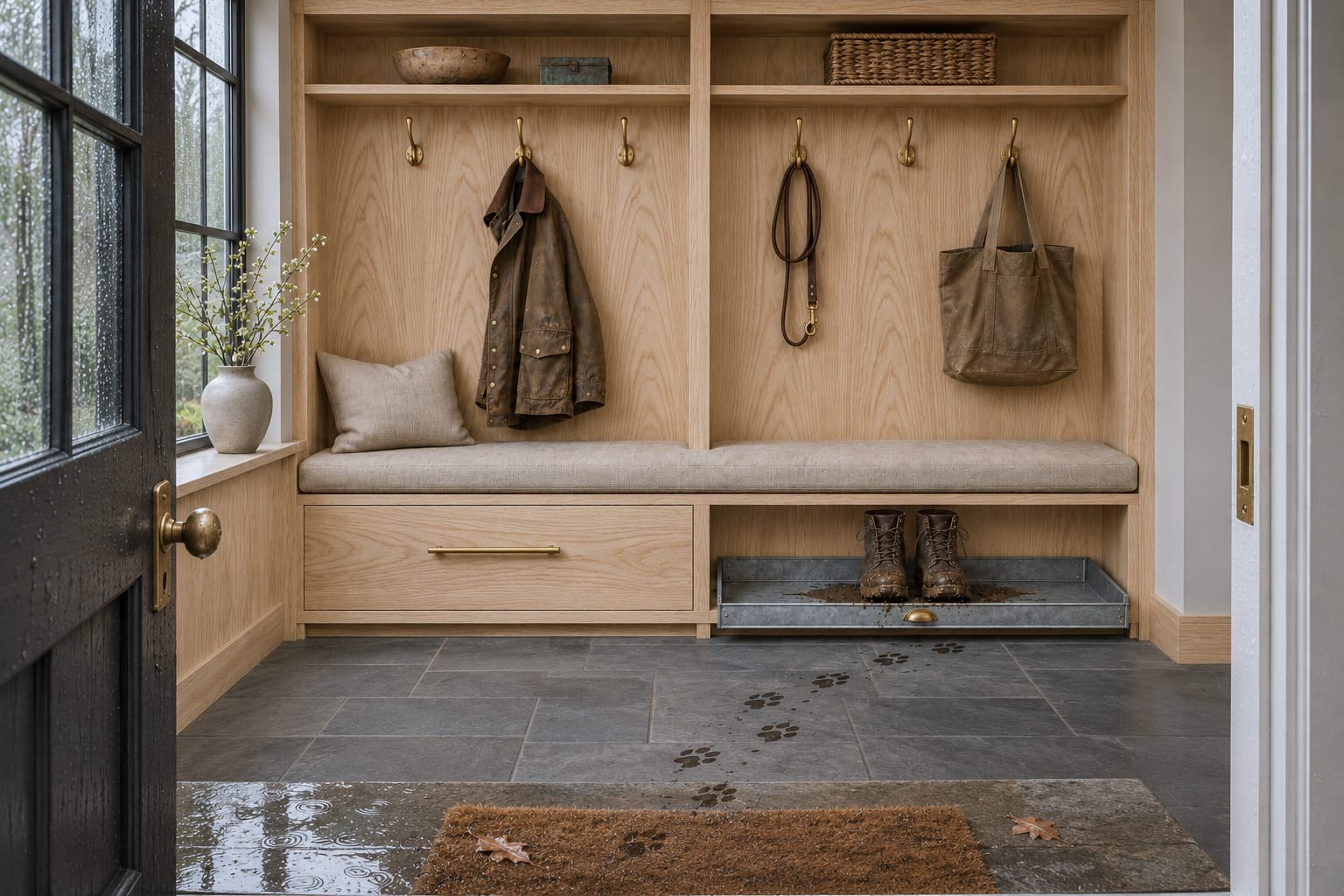
In from the rain
The slate runs from the door to the bench, so the first steps land on stone.
Fig. 5.2
- 02
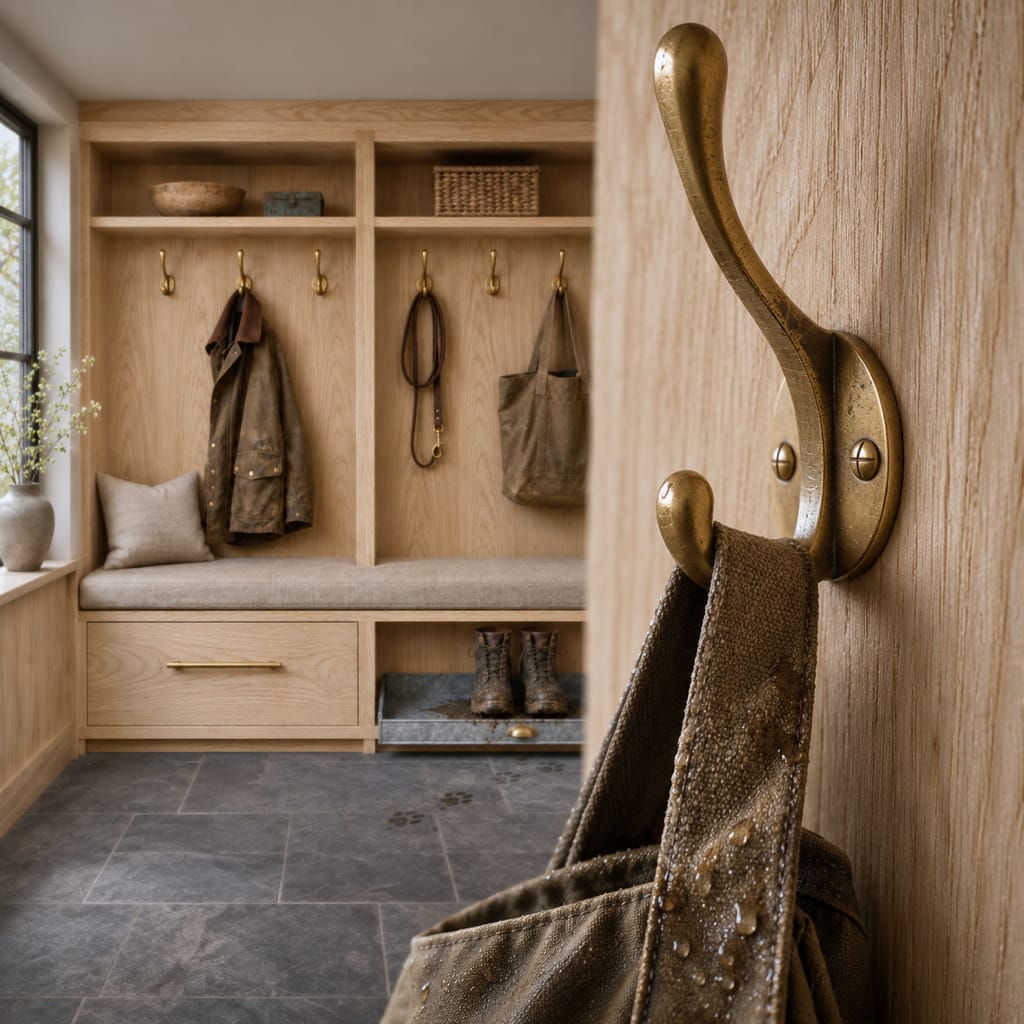
Hang it up
A hook for each person on the back panels, and a double hook on the end panel for the wet bag.
Fig. 5.3
- 03
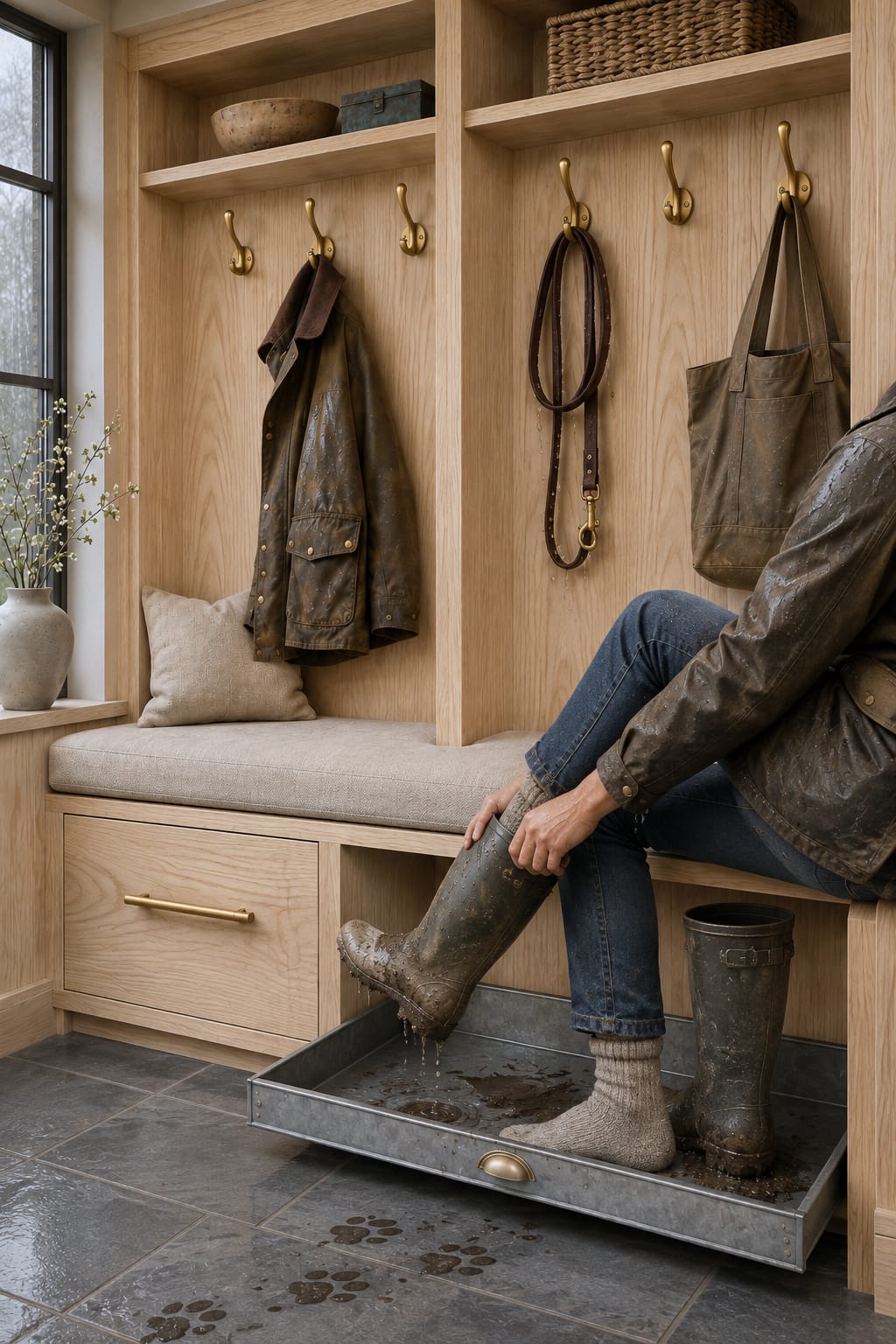
Sit, boots off
The bench is eighteen inches high: a comfortable height to sit and pull a boot.
Fig. 5.4
- 04
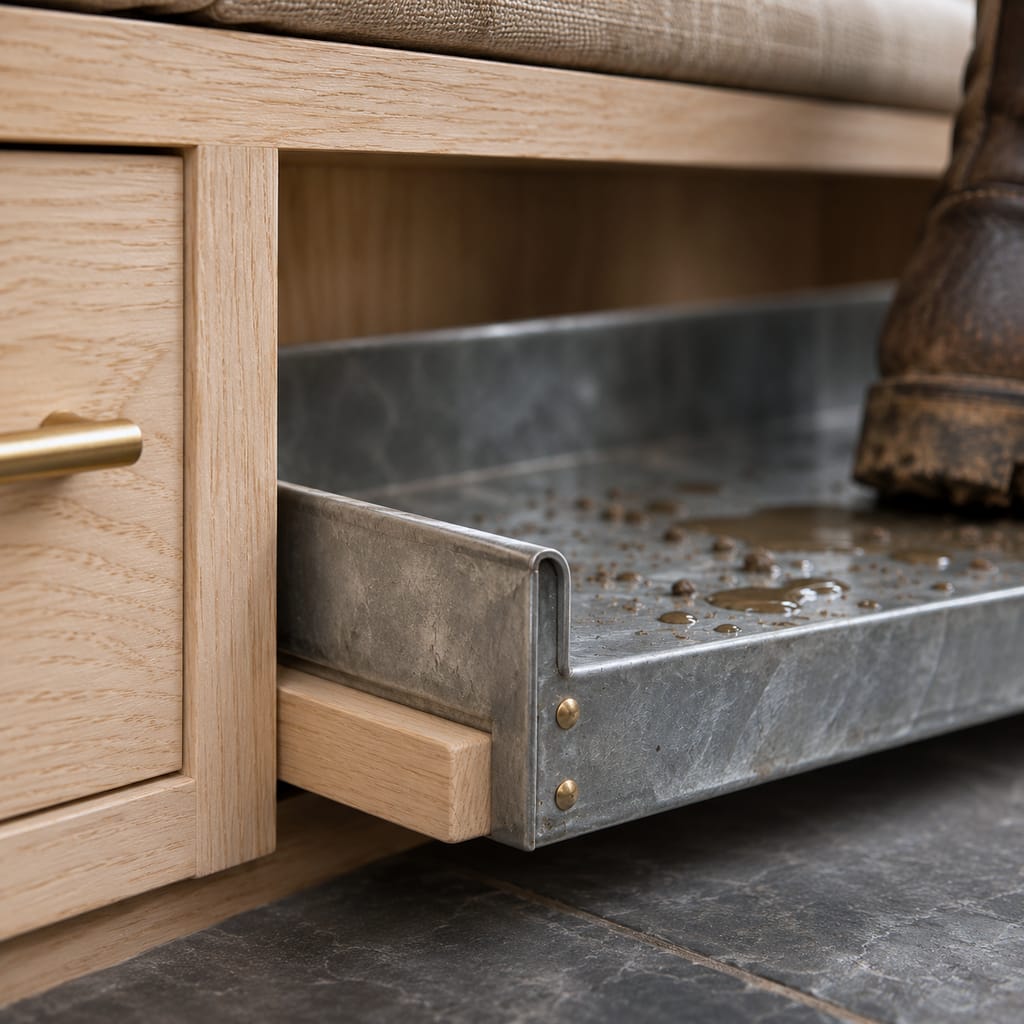
Boots in the tray
The zinc tray slides out on its runners and lifts away to rinse.
Fig. 5.5
Sheet A-05.1 · Plan
Where everything is.
Every photograph on this sheet was taken from a numbered station on the plan. Choose one to stand there.
Under the bench
A tray that leaves the room
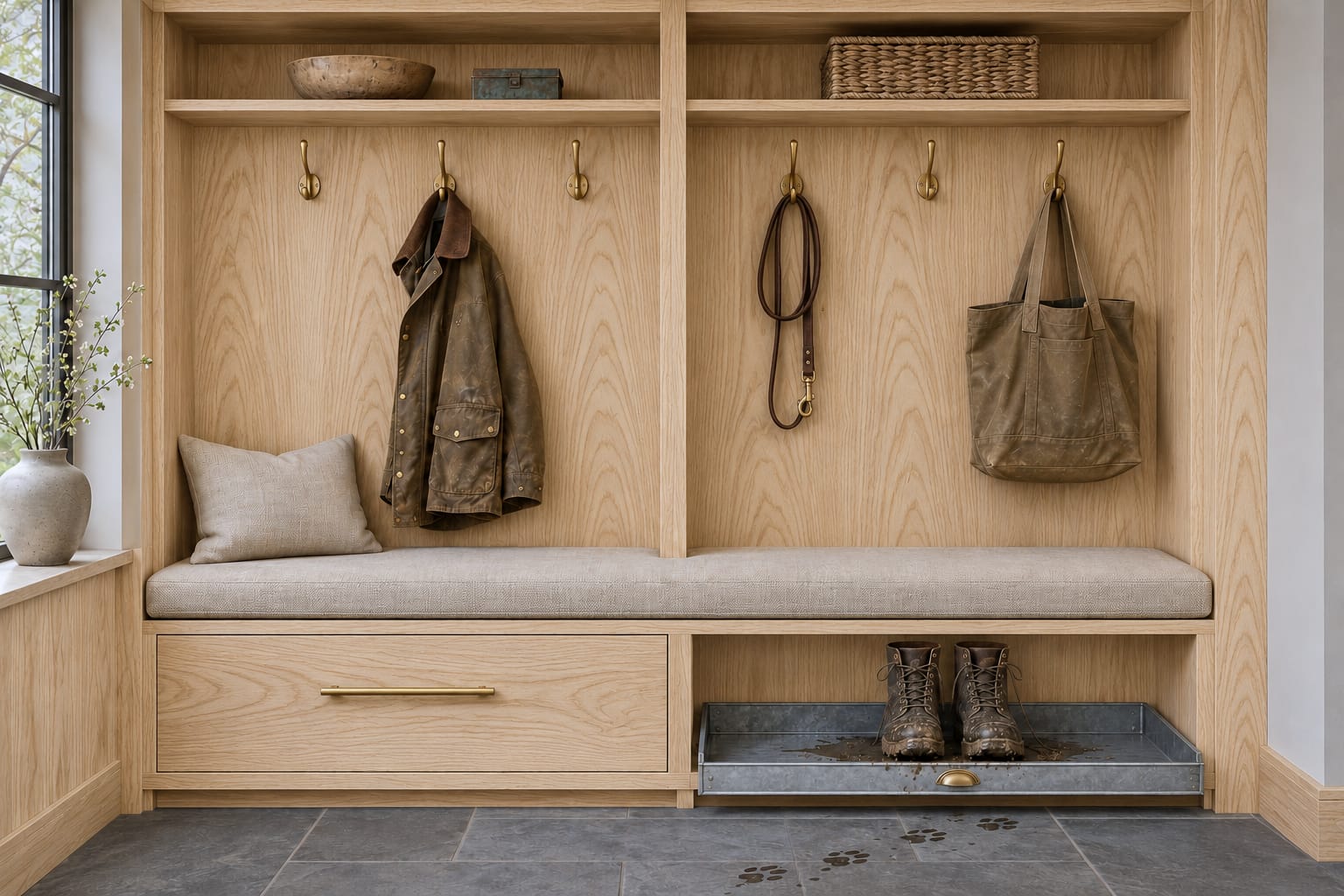
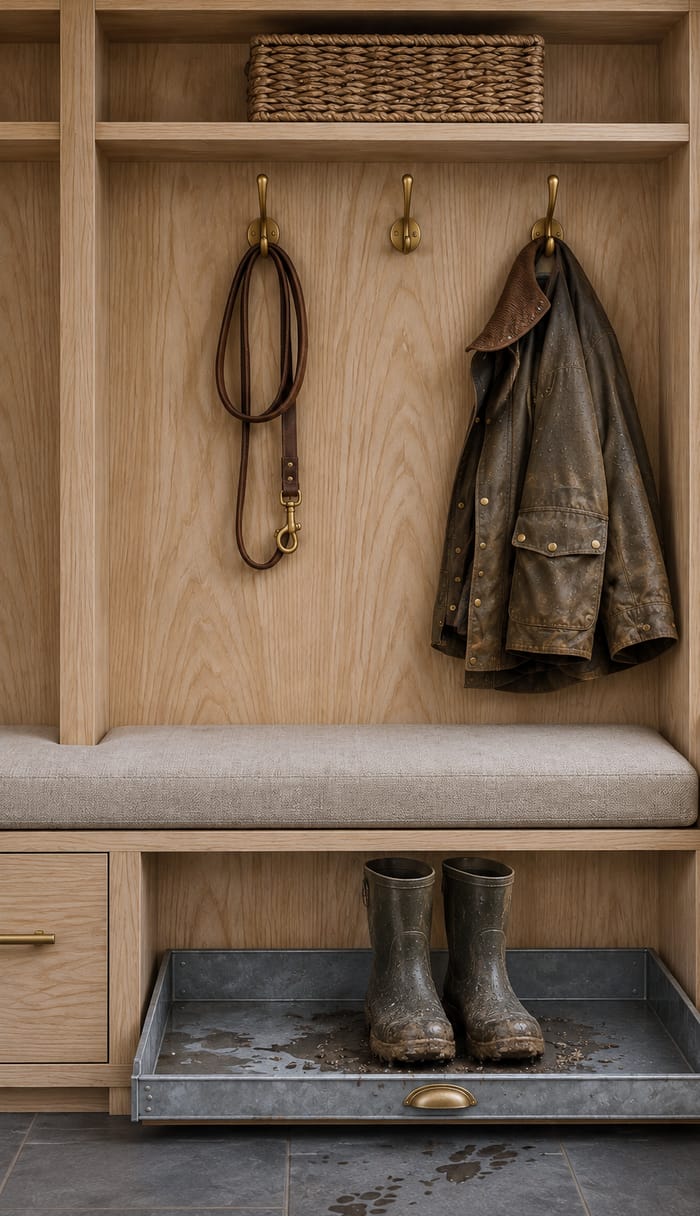
Under the right half of the bench, a zinc tray with a folded lip slides out on solid ash runners and lifts away to be rinsed in the yard. Wet boots stand in zinc, not on wood.
Under the left half, a drawer for gloves, leads and dog towels.
On the wall
Hooks that stay put
The six hooks on the back panels are bolted through the ash into blocking set in the wall. The double hook on the end panel has no wall behind it, so it is bolted right through the panel to barrel nuts on the far face. Either way, a wet raincoat and a loaded bag can hang from the same hook.
Bench: section through the tray, the runner and a hook
- 1Blocking behind the back panel
- 2Back panel, white ash
- 3Solid brass hook on the back panel, bolted through into the blocking
- 4Linen cushion (by the upholsterer)
- 5Bench top, solid ash
- 6Solid ash runner, waxed
- 7Zinc tray with a folded lip; it lifts off to rinse
- 8Recessed toe space, sealed on every face
- 9Slate floor
Red: a finished face. Hatch: solid wood, cut.
Drawn, then built.
- Status
- Drawn
- Sheet
- A-05.2 · Fig. 5.6
The elevation
Mudroom wall, dimensioned elevation
Drawn before anything was cut, and laid here over the finished wall. Scroll on and the drawing lifts off the room.
The finished room
Fitted, and photographed
The wall straight on: two bays, a bench, a drawer and a tray. The main dimensions stay on the photograph.
Detail 1 of 4
An open shelf above
Across the top of both bays: the open shelf, over the hooks.
Detail 2 of 4
Hooks that stay put
On the back panel of each bay: three hooks in a row. The double hook is on the end panel, out of this view.
Detail 3 of 4
A tray that slides out
Under the bench at the right: the boot tray, pulled half out.
Detail 4 of 4
Sealed at the floor
Along the floor: the recessed toe space under the bench.
Bench to back door
From the shopto every wet morning.
01In the shop
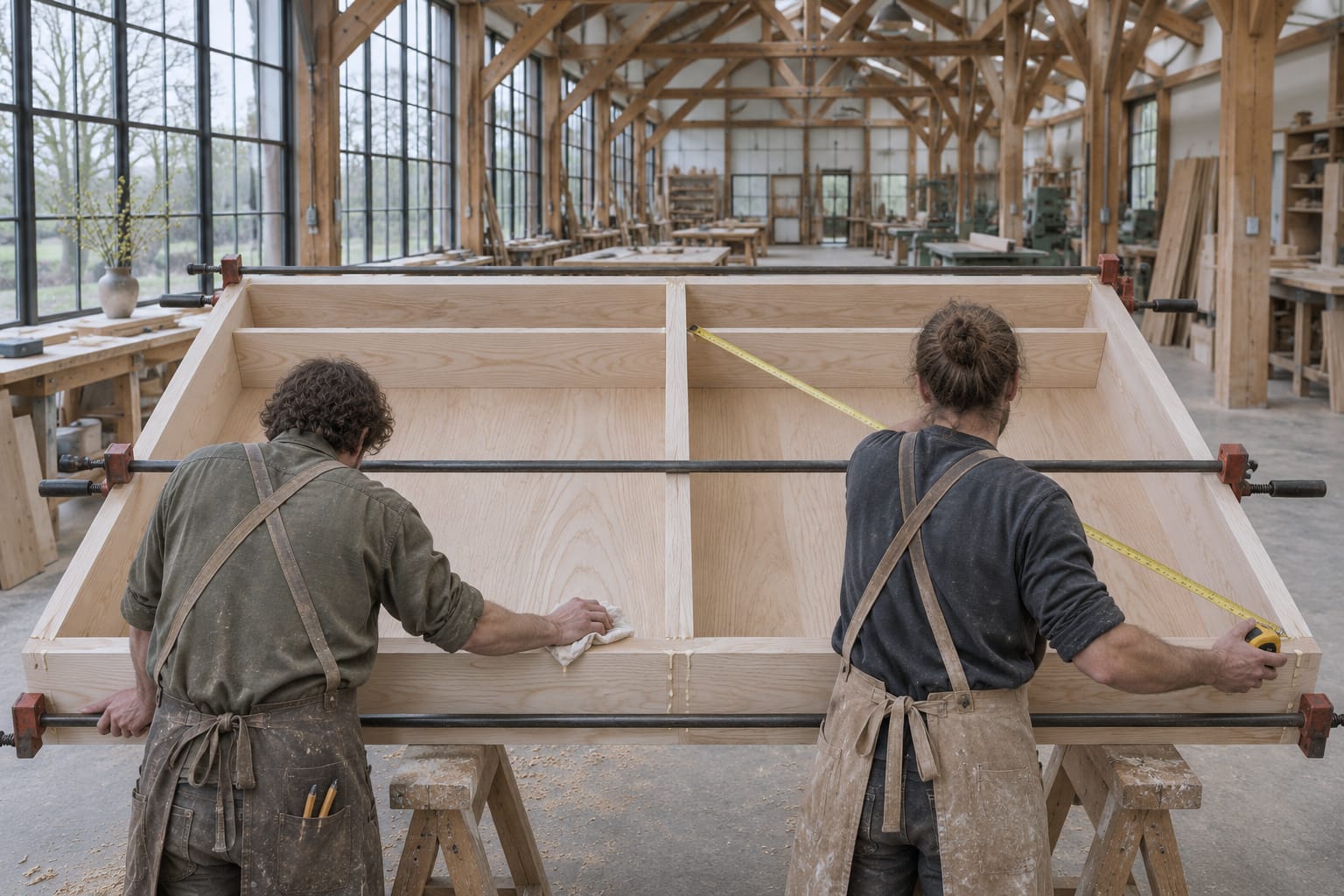
Fig. 5.7Glue-up: checked square across both diagonals, because the house will not be. Two bays on one frame, then hardwax oil on every face, end grain included, before anything is loaded on the truck.
02Fitting day
Scribed to the house
The frame is set level and the end panels are scribed to the plaster. The runners are waxed and the tray set on them, and every hook is pulled by hand with a loaded bag before we leave.
03After a walk
Fig. 5.8The right-hand bay after a walk. The lead back on its hook, the jacket dripping onto ash oiled for it, the boots standing in zinc.
04The first season
Back once, to adjust
After the first winter we come back: the runners re-waxed, the drawer and the tray checked for an even run, and a thin coat of hardwax oil wherever boots have scuffed the ash.
Caring for hardwax oil
Sheet A-05.3 · Details and schedule
Four details.
Each one in full: the problem and the answer. Open a study for how it is made and what we check.
Detail 1
An open shelf above
The problem. Hats, gloves and baskets that need to dry.
The answer. An open shelf above the hooks instead of doors, so nothing damp is shut away.
Detail 2
Hooks that stay put
The problem. A wet coat and a loaded bag on one hook.
The answer. Solid brass hooks, through-bolted: into blocking set in the wall behind the back panels, and right through the end panel to barrel nuts on its far face.
Detail 3
A tray that slides out
The problem. Muddy boots, and wood that should never stand in water.
The answer. A zinc tray on solid ash runners that slides out and lifts away to rinse.
Detail 4
Sealed at the floor
The problem. A floor that is mopped every day.
The answer. A recessed toe space, sealed on every face, so the mop reaches the slate under the bench.
Finishes and hardware.
What each part is made of and how it is finished. Hardware marks refer to the hardware study.
| Part | Material | Finish |
|---|---|---|
| Lockers, bench and shelf | White ash, solid and veneered panels | Hardwax oil, spot-repairable |
| Boot tray | Zinc, folded lip, on solid ash runners | Ash runners waxed |
| Bench drawer | Hard maple box, ash front | Hardwax oil |
| Hooks | H-2 solid brass, through-bolted to blocking | Left to patina |
| Cushion | Linen, by the upholsterer | — |
Next · No. 01 · Kitchen · Black walnut
Dahlonega kitchen
Black walnut and honed limestone in an 1890s farmhouse: two cooks, one long wall, and a ceiling that falls two inches.